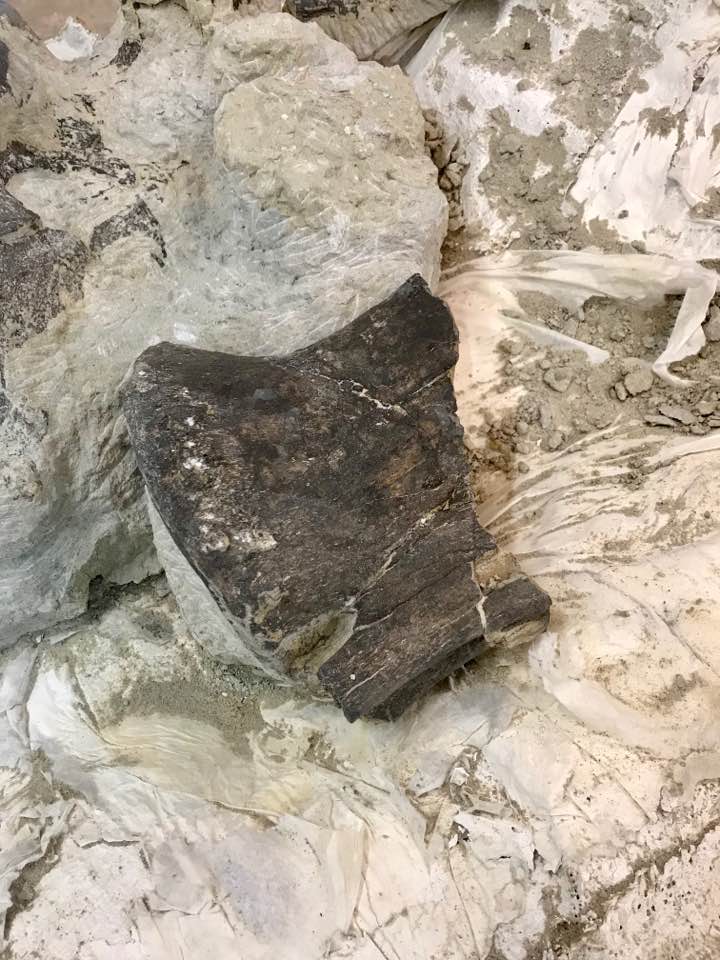
We got a whole vertebra out of the jacket!! *happy dance*
This past Thursday, Sara spent time in the lab and with Rick's help we have a vertebra entirely removed from the matrix in the jacket!
The vertebra was removed along natural break lines that formed in the ground pre-excavation. These lines made it easy to piece it back together once extracted from the jacket.
A small fragment of this vertebra remains in the jacket, and can be adhered later on when we can get it safely out.
In the meantime, Rick has sealed it up with some glue so that it is not damaged.
Here it is! The first caudal vertebra out of the jacket that Jodie and Sara started a year ago to the day.
Not many of you know, but one of the ladies in our lab is Canadian! This is a video from her old stomping grounds, Toronto Ontario Canada which shows the mounting of a complete Barosaurus skeleton in the Royal Ontario Museum. This skeleton was discovered in their archives back in 2007 and was quickly put back together. (Story and link below the video)
This video is older, but it shows you what we hope to have once we are done the preparatory work on our own Barosaurus.
"This is a fascinating and somewhat humorous story, and one the Museum is extremely pleased to tell,” said the ROM’s Director and CEO William Thorsell.
Dr. David Evans, new Associate Curator of Vertebrate Palaeontology in the ROM’s Department of Natural History, found the ultimate “skeleton in the closet.” Arriving in May 2007 to head up the ROM’s dinosaur research program, one of his first jobs was to find a sauropod dinosaur for display in the new Age of Dinosaurs gallery. The ROM’s new gallery already included excellent specimens of three of the four most recognizable dinosaur types – T.Rex, Triceratops, and Stegasaurus – but none of the largest dinosaurs, the sauropods.
After spending months investigating options, including purchasing a cast or even digging one up, Evans found what he was looking for in an unexpected place. While on a related trip to Wyoming, he was reading an article by famed sauropod expert Jack McIntosh when something caught his eye -- a reference to a Barosaurus skeleton at the ROM. The ROM’s databases turned up a blank, but after connecting the disparate dinosaur dots Evans was able to show that what were thought to be isolated bones scattered throughout the collections room actually belonged to a single dinosaur.
"It was an exciting day,” says Evans. “We were searching for an iconic sauropod skeleton, and we had one under our noses the whole time. When all the parts were pulled together, we realized just how much of the animal the ROM actually had -- the better part of a skeleton of a rare, giant, dinosaur.”
The Barosaurus skeleton includes four massive neck vertebrae, a complete set of vertebrae from the back, the pelvis, 14 tail vertebrae, both upper arm bones, both thigh bones (each of which is over 140 cm (55 inches) in length), a lower leg, and various other pieces. The entire assembled skeleton is approximately 27 metres (90 feet) in length, and when alive the animal would have weighed as much as 15,000 kilograms (15 tonnes)."
Welcome back to PaleoLab! This weekend we made a trek into the hills (and the desert) to find fish fossils. We met at 6:30 and collected our gear and water and headed out of state to an awesome location in Wyoming. Jodie and Sara had husbands in tow. Once we arrived at our quarry we were loosed on an amazing wall of sandstone that had settled in sediment layers which were easily pried loose with a rock hammer and a chisel.
Rick Hunter
In this image you can see an ash layer of orange at Rick's eye level. Not all, but the majority of fish found were near or below this layer. The formation is one of the largest lacustrine (i.e., lake) sedimentary accumulations in the world, averages some 2,000 feet thick, and spans the period 40 to 50 million years ago during the Eocene Epoch of the Cenozoic Era. (Data credit http://orerockon.com)
Jodie Kevin Jodie: Six hours straight of dismantling a cliff, inch by inch, with a hammer and chisel and then breaking each piece into thin sheets with said chisel and hammer not only helps you find cool fossils, it turns your arm muscles into jelly. I've done my arm workout today.
Fish Fossils - Kevin found some cool ones!
Sara Justin
Sara: We were blessed to be in a location where the sun creates a pocket of shade precisely where we were standing to excavate. The heat was not overly intense, but the direct rays could have made for devastating sun burns. You see, we were so involved in our fish finding, that it was easy to forget to drink water or apply sunscreen!
Bryn
Bryn: Oh. Hello there little guy! I wonder who you belong to....
Bryn is our resident geologist and lab cohort. Nearly every rock that she lay eyes on managed to spark her excitement. It was amazing to have her with us.
Bryn, Sara, Rick
Rick, Jodie, Kevin
A crate of excavated Fish.
Justin and our tent headquarters.
Packed up and ready to roll out for dinner!
This little guy is amazing!
This is the head of a large fish, you can likely imagine a Pike and be close to shape and length.
You can almost imagine them swimming through the matrix.
This trip was an incredible experience and we are all very excited to return again soon!